


Tenkara Combinations: The Dry Fly Setup
|
|
Time to read 6 min
Cart
Your cart is empty
|
|
Time to read 6 min
Tenkara Combinations: A Simple Setup That Still Has Options
You have probably heard that tenkara is simple. And yes, it can be. The whole point is that you can fish with a lot less gear than traditional fly fishing. But the “simple” part doesn’t mean every setup is the same.
Your rod, line, tippet, and fly can change a lot depending on where you’re fishing and what you’re trying to do. So I want to talk about one of my favorite combos: a dry fly setup. This post is not about technique. It’s about the gear combo, and how to think about it.
Table of Contents
The first decision is the rod.
A solid starting point for most people is 10 to 13 feet.
Shorter if you mostly fish small creeks and tight water
Longer if you mostly fish bigger rivers and open water
These days, my personal go-to is the Backpackr, mostly because it removes a lot of guesswork. It gives me three different lengths, but still packs down super small. Unless I know I’m only fishing tiny water all day, I usually grab the Backpackr.
It’s also handled a wide range of fish for me. In my experience it does great on trout in the 8 to 24 inch range.
So for this example, I’ll use the Backpackr. Not because it’s the only option, but because it’s the most versatile one I reach for.
Once you’ve got a rod, the next piece of the puzzle is the line.
I think of line in three main purposes:
Floating (dry flies on the surface)
Hybrid (a mix of surface and subsurface)
Subsurface (nymphing, wet flies, deeper presentations)
This post is dry-fly focused, so we’re talking floating.
If your fly is on the surface, your line needs to float too. If your line sinks, it messes with your drift and it pulls your fly around in ways that don’t look natural.
For a floating setup, I like a lightweight PVC line.
Regular fly line can work, but I personally think it’s often too heavy for tenkara. Traditional fly line is built to shoot and cast far. With tenkara, we’re not doing that. We’re trying to control the drift at close to medium range, and keep as much line off the water as we can.
Another issue I have with standard fly line is how stiff it can feel where it transitions into tippet. Sometimes the drift gets a little weird.
And yeah, it’s funny when you zoom out and remember what we’re doing here. We’re trying to trick a wild fish into eating a fake bug. It’s ridiculous. But it’s also the best.
Anything that gets me outside, into that flow state, and tuned out from the noise of the world is a win.
Over 10 years ago we made our first Crossbreed line.
The idea is simple:
A specific diameter PVC line that floats well and drifts clean
Then about 2 feet of furled line at the end
The smaller diameter PVC helps keep the line light and off the water. It also floats really well. Then the furled section on the end is even lighter, which helps the drift stay clean.
I’ve caught thousands of fish on this setup over the years with dry flies.
And if I’m being honest, I really love dry flies on a tenkara rod. Almost as much as kebari.
The fly (keep it simple)
I’m not going deep into fly selection here. We’ll save that for another post.
What I will say is this: tenkara is excellent at maintaining a good drift and staying connected to the fly.
Some of my favorite fishing memories are hiking into spots that don’t get pressured much, watching a big bug land on the surface, and then seeing a wild trout open its mouth and eat it.
I also love the act of casting a dry fly because you can watch it land and track it with your eyes. There’s something therapeutic about it. And tenkara keeps you moving. We don’t have extra line to reach farther, so we use our feet.
Most of my dry fly fishing looks like this:
summertime
high mountain lakes
cold rivers
eager trout
simple flies
But I also love a good hatch.
When fish are actively rising and eating, it’s fun to sit there with your fly box and try to figure out what they’re keyed in on. I got really into dry flies from a Boise guy named Nate at Dry Fly Innovations. I took one of his classes years ago, bought his flies, and I’ve been fishing them ever since.
Some of my best days have been sitting on a bank and cycling through a bunch of patterns until the fish finally eats.
If you’re fishing dry flies, tippet matters.
For me:
5X is my usual default
4X if I’m fishing bigger flies or a rougher river
I almost never use 3X for dry flies because it can be too obvious
6X is a little light for me, mostly because I don’t like losing flies
Tippet length: it depends, but most of the time I’m around 3 feet.
Sometimes more if fish are spooky and I want my line farther away
Usually no less than 2 feet
And remember, if you’re changing flies a lot, your tippet is going to get shorter anyway
My favorite style of dry fly fishing is the kind where you’ve put in the work to get to the spot, and the fishing is relatively easy.
So my go-to is usually a size 12 or 14 Stimulator.
But you should absolutely experiment. All it takes is one magical day with a fly and suddenly it becomes your confidence pattern for the next 10 years.
If you want the simple version, here it is:
Rod: something in the 10 to 13 ft range (I often use the Backpackr for versatility)
Line: floating PVC line (Crossbreed style is my favorite)
Tippet: 2 to 4 ft of 5X (or 4X if bigger flies or rough water)
Fly: any dry fly you like, Stimulator 12-14 is a great start
Floatant: helpful if your fly starts to drown
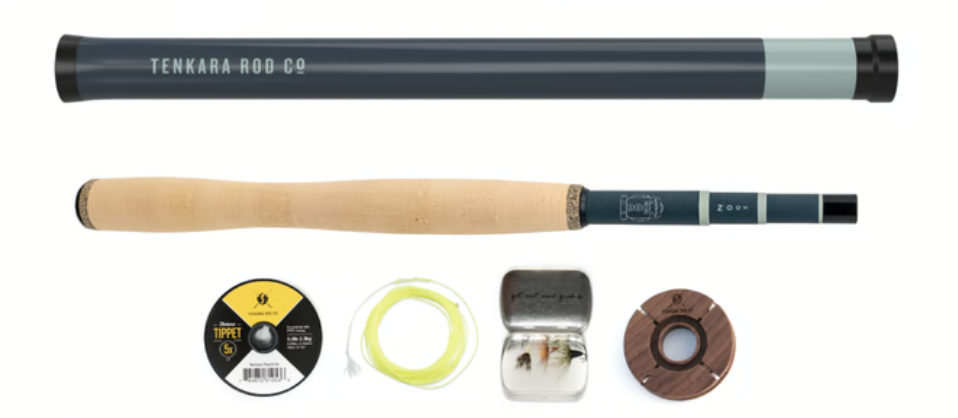
We have tried to make dry fly fishing with a Tenkara rod as simple as possible. Our Dry Fly Kit Bundle includes a 13' crossbreed line, 12 pack of our favorite dry flies, a line holder, and tippet. So you can grab the bundle and get on the water.
Quick note about “traditional” tenkara
Now for a disclaimer.
Dry flies on a tenkara rod are not the traditional Japanese style. Some people might call me a heretic for even talking about it.
Traditional tenkara is built around kebari, and I’ll write about that next.
But to me, tenkara isn’t strict. It’s more of a mindset.
I lived in Japan for 6 years, and one thing I love about Japanese culture is the blend of traditional and modern. They love their culture, but they also love embracing new ideas. There are vending machines everywhere, thousands of McDonald’s, and a real appreciation for American stuff too.
We’ve sold thousands of tenkara rods in Japan even though we’re a U.S. company. A lot of people over there think it’s fun that the U.S. is embracing tenkara.
So in that same spirit, we’ve embraced tenkara in our own way.
To me, it is very tenkara to hike five miles into a backcountry river, cast a dry fly in the middle of summer, and enjoy the whole thing.
So put down your phone, grab your setup, and get out and fish.
And give dry flies a try sometime.
Maybe it’s not your thing. Or maybe you’ll love it.
The Author: Drew Hollenback
Drew is the founder of Tenkara Rod Co. He has been an avid Tenkara angler for over 15 years. He founded TRC in 2012 and is obsessed with this style of fishing and enjoying the outdoors as much as possible.
Products Featured In This Blog